


Your Flat Roof Is a Heat Magnet. NIPSCO Loves That.
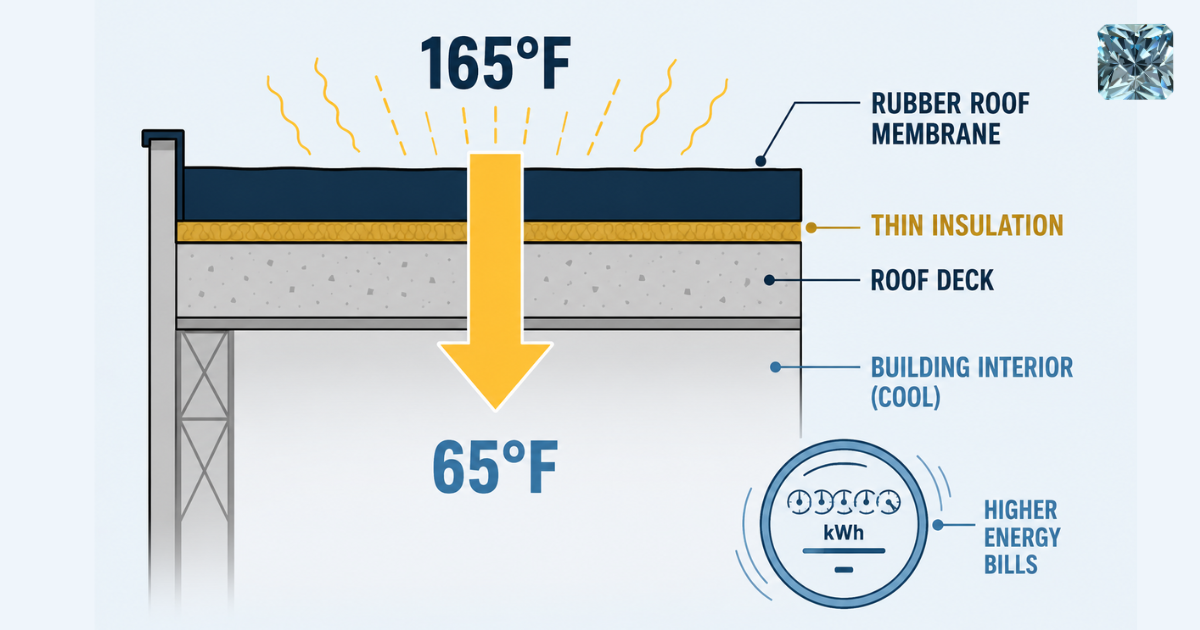
A dark, thin roof bakes past one hundred sixty degrees all summer while you fight to hold sixty five inside. A hundred degree tug of war, and you pay for every round of it.
The fix is two words. Thicker and brighter. Put the inches back, bounce the sun, and quit handing NIPSCO a quarter to nearly half your summer cooling bill for nothing.

Five Reasons to Keep Reading
🔲 You are already losing the money. This is about stopping it. Nobody gets excited to save. Everybody wants to stop bleeding. Your roof is a slow leak in your bank account every summer month.
🔲 It is not just color. It is thickness. A bright roof that is still thin still loses. The word most owners never hear from a roofer is thicker, and it is half the answer.
🔲 Most roofs we open are barely half of code. The average roof we core sample has about two inches of insulation. Today's standard for our climate zone is closer to five. You are paying the gap every month.
🔲 The storms made your thin insulation even weaker. Wet insulation loses most of its resistance, and this June soaked a lot of roofs right before the hottest stretch of the year.
🔲 NIPSCO is not going to stop, so the roof is the lever you actually control. You cannot switch providers. You can decide how much heat your building lets in and how many of their expensive electrons you waste fighting it.
The short version.
Do not think about savings. Think about loss. Right now your roof is losing money in three ways at once. It is dark, so it absorbs the sun and bakes past a hundred and sixty degrees. It is thin, so that heat transfers straight through into the building. And the insulation you do have has almost no resistance left, because the average flat roof we core sample across the six counties holds only about two inches, roughly half of what today's code even calls for. Add a summer of storms that soaked what little insulation is up there, and the loss compounds. The fix is not a gimmick. It is thicker and brighter. More inches of resistance, and a bright reflective surface on top. This article shows you exactly where the money is leaking and what it costs to stop it.
Quick Answers Before You Dig In
What does R-value even mean?
R stands for resistance. It is your roof's resistance to heat moving through it, in or out. Higher R-value means more resistance, which means less heat sneaking through, which means a smaller cooling bill in July and a smaller heating bill in January. Insulation earns its R-value by trapping air in millions of tiny closed cells, and trapped air is one of the best heat blockers there is. Most owners have never been told the number for their own roof. It is one of the most expensive numbers you do not know.
How thick should my roof be?
Polyiso foam boards, the rigid walkable four foot by eight foot sheets used on most commercial roofs, deliver about six units of R-value per inch when fresh and about five and a half to six over the long haul. Today's energy code for our climate zone calls for roughly R-25 to R-30 above the deck, which is about five inches. The average roof we core sample has about two inches, or roughly R-11 to R-12. That is barely half of standard. Push past about R-50, which is eight or nine inches, and you hit diminishing returns. But anything under R-30 is a real, fixable loss.
What does overlay actually mean?
Overlay means we lay new resistance directly over your existing roof instead of tearing it off. Fresh rigid polyiso boards go down, glued or screwed to what is already there, fully within code, in staggered layers that also break up the shortcuts heat likes to take. Then a bright reflective surface goes on top. Thicker and brighter, in one pass, without the cost and mess of a full removal.
Why does my NIPSCO bill keep climbing?
Rates have jumped, and they are not done. But the utility is only half the story. The other half is sitting on top of your building. A thin, dark, wet roof forces your cooling system to run harder for the same comfort, and every extra minute it runs is money you hand NIPSCO on top of the rate hike. You cannot control the rate. You can control the roof.
Grab a Coffee. Let Us Talk About the Loss.
Everybody is mad about the bill, and everybody is right.
You are not imagining it and you are not alone. The whole region is fired up at NIPSCO, the summer has been brutal, and the air conditioner has been running like it owes somebody money. So let us not sell you anything for a minute. Let us just name what is actually happening on top of your building, calmly, and then you can decide what to do about it.

Here is the mindset shift. Do not calculate savings. Calculate loss.
Nobody wakes up excited to save money on a roof. But everybody feels a loss. So be honest with yourself. Every hot month, your roof is losing you money three different ways at once, quietly, whether you look up or not. You are not being asked to chase a savings gimmick. You are being shown a leak, and where the shutoff valve is.
Nobody wants to save. Everybody wants to stop losing.
Your Roof Is Fighting a Hundred Degree War Every Summer Day
Think about the two numbers your roof lives between.
On a hot afternoon the top of a dark flat roof bakes to a hundred and sixty degrees or more. Inside, you are trying to hold sixty five. That is roughly a hundred degrees of difference stacked across a few inches of roof, and nature hates that gap. Heat always runs toward cold, no days off. All day, every day, that hundred degree pressure shoves heat down into your building, and your cooling system is the only thing pushing back.
The thinner and darker the roof, the less it resists that shove, and the harder your equipment works. That is not comfort. That is a meter running. The roof is the referee in a hundred degree fight, and right now it is throwing the fight.

Three Ways Your Roof Loses Your Money
This is bigger than color. There are three separate leaks.
1. It absorbs. A dark surface soaks up the sun and turns it into heat instead of bouncing it away. Same sun, same building, but a black roof chooses to keep the heat. This is the brighter half of the fix.
2. It transfers. Heat takes the shortcut. Through thin insulation and through the metal fasteners holding a roof down, warmth bridges straight through to the inside. Builders call it thermal bridging. You call it a warm ceiling and a loud air conditioner.
3. It has no resistance left. Two inches of insulation simply cannot slow a hundred degree pressure. There is not enough trapped air up there to hold the line. This is the thicker half of the fix.
Most roofing ads only ever mention the first leak, color, because a coating is easy to sell. But a bright roof that is still two inches thin is a bright roof that still loses. You have to close all three leaks, and two of the three are about thickness.
R-Value in Plain English, and the Number You Do Not Know
R-value is just your roof's resistance to heat. Higher is better.
Picture a coat. A windbreaker and a thick winter parka are both coats, but one holds the line at zero degrees and one does not, because one traps far more air. Roof insulation is the same. Polyiso foam traps air inside millions of sealed cells, and the more inches you stack, the more resistance you build. That resistance is the R-value, and it is the single number that decides how hard your cooling system has to fight.
Now the uncomfortable part. We measure real roofs, and the number is low.
When we pull a core sample, a small plug cut clean out of the roof so we can see every layer, the average flat roof across the six counties shows only about two inches of insulation. That is roughly R-11 to R-12. Today's commercial energy code for our climate zone asks for something closer to R-25 to R-30, which is about five inches. So the typical roof out here is running at barely half of the current standard, and has been quietly losing the difference for years.
The average roof we open is at half of code. You are paying the other half to NIPSCO.
More is better, up to a point, and then it is not.
Resistance is not infinite in value. Somewhere around R-50, roughly eight or nine inches, each added inch gives back less and less, and it stops being worth the cost. That is the ceiling. But almost nobody out here is near the ceiling. Most roofs are under R-30, which is exactly the range where adding inches pays off hardest. If your roof is thin, the first few inches you add are the most valuable inches on the whole building.
The Storms Made Your Thin Insulation Even Weaker
A wet inch of insulation is barely an inch at all.
Here is where this summer bites twice. Independent testing has found that some fibrous roof insulation loses more than sixty percent of its resistance once it gets soaked. The wind and rain of June did not just threaten leaks. They pushed water into roofs that were already too thin, and wet insulation stops resisting heat almost entirely. So a roof that started at a weak R-12 can quietly drop to a number that barely counts, right as the hottest stretch of the year arrives. We wrote the whole storm story in a companion piece if you want the play by play.
See the companion article, The Summer the Sky Lost Its Mind, on PristineIndustrialRoofing.com
Nance: You run the numbers, so hear this one plainly. A roof at half of code is a fixed monthly loss hiding inside your utility line. Closing that gap does not just cost money. It stops an outflow you have been eating every summer for years.
Kenny: You keep all these buildings running, so you are up there in July feeling it radiate off the surface. That heat coming through your boots is the exact heat the air conditioner is paying to pull back out. You have been standing on the leak this whole time.
Bill: You own the asset. A thin, dark, damp roof is the largest underperforming part of your building. Making it thicker and brighter protects the structure and cuts the loss in the same move. Few upgrades do both.
The Fix Is Two Words. Thicker and Brighter.
Say it the way people actually feel it. Thicker. And brighter.
Brighter is the surface. A bright reflective top coat or membrane bounces the sun back into the sky instead of letting the roof drink it in, so the surface runs fifty degrees cooler or more. Thicker is the resistance. We add rigid polyiso foam board, the walkable four by eight sheets that make up most commercial roofs, to build the R-value back up to where it should have been all along. Brighter does not just make you smarter. It makes your roof smarter. And thicker is the word nobody else will say, because it is the honest one.
Here is what thicker and brighter looks like on a real roof.
Say your roof has the usual two inches, about R-12. We overlay three fresh inches of high density polyiso, glued or screwed down over the existing roof, fully within code, in staggered layers that also break up the thermal shortcuts. Now you are at about five inches, roughly R-30, right up to today's standard. Then we cap it with a bright surface, either a seamless liquid reflective system or a vinyl membrane. In one pass the roof went from thin and dark to thick and bright, without a full tear off.
You can pay for insulation once, or pay NIPSCO for missing insulation every month forever.
Combine the two, bouncing the sun and rebuilding the resistance, and the cooling energy that drives your summer bill can drop by roughly twenty five to forty percent. That is not a savings pitch. That is the size of the loss you get to stop.
Why the Anger at NIPSCO Is Justified, and Why It Keeps Rising
The rate went up sharply, and more is coming.
The most recent rate case raised the average bill almost seventeen percent, and consumer advocates put the real climb through early 2026 at more than twenty five percent, among the steepest in the state. People are right to be fired up. And it is not going to stop, because demand on the grid is about to jump as large data centers move into the region and the utility projects it may need to add capacity many times its current peak to serve them.
But we are not going to blame only the data centers or only the policy.
There are plenty of factors in that bill, and one of them is your own building. A thin, dark, wet roof inflates your share of the total, month after month, no matter what the rate does. That part is not NIPSCO's fault, and here is the good news buried in that. The part your roof controls is the part you can actually fix. You cannot fire NIPSCO. You can fire the loss.
You cannot fire NIPSCO. You can fire the heat your roof lets in.
And there is a quiet turn most owners miss. The reduction in your cooling loss can help pay for the roof improvement itself. The upgrade is not only an expense. Over its life it hands part of the cost back every summer, in the form of a smaller bill for a comfort you were already buying at full price.
The Math of Your Loss
Do not estimate your savings. Measure your loss. It is simpler and more honest.
Pull your worst summer NIPSCO bill, a July or August statement. A large share of that number is cooling, and cooling is the exact load a thicker, brighter roof attacks. Take twenty five to forty percent off the cooling portion and you are looking at the money a thin dark roof has been quietly costing you every hot month. Do that across every summer you keep the roof as it is, and the loss is not small. It is one of the larger recurring line items on the building that nobody ever put a name to.
What You Can Actually Do About It
Three honest answers for three roof conditions. A menu, not a pitch.
1. Should we patch it? When the roof is basically sound and just needs a few spots addressed, a targeted repair keeps water out and buys time. It protects what you have. It will not change the loss much, because it does not add resistance or brightness.
2. Should we go seamless and bright? When the roof is sound but dark and aged, a seamless liquid reflective system seals the whole surface and turns a heat magnet into a reflector, with a renewable twenty year warranty. No heat, no open flame, no torch. This closes the brightness leak.
3. Should we add thickness to the resistance? When the roof is thin, an overlay adds fresh polyiso inches over the existing roof and caps it with a bright liquid or vinyl surface. This closes all three leaks at once and can move the roof toward a full new system warranty of twenty five years or three hundred months. Thicker and brighter in one pass.
One Address. One Honest Look.
You do not have to decide today. You just have to point us at a roof.
Pick one commercial property in your portfolio, the one whose summer bill makes you wince, and send us the address. Scan the code on the card or text it to us. We will pull it up, and where it makes sense we will take a core sample so you finally see the two numbers that decide your bill, how thick your insulation really is and how much resistance is left. Then we come back with a straight read and the menu above. No pressure, no fantasy percentages, no torch on your roof. Just a local company showing you where the money is going and how to stop it.
Text us one address: (219) 529-1995

For which of you, intending to build a tower, sitteth not down first, and counteth the cost, whether he have sufficient to finish it?
Luke 14:28
Where These Numbers Come From
- Polyisocyanurate Insulation Manufacturers Association and manufacturer data, on polyiso R-value per inch, fresh and long term design values.
- International Energy Conservation Code 2021 and ASHRAE 90.1, on minimum above deck roof insulation for our climate zone and on the two layer staggered joint requirement.
- U.S. Department of Energy and ENERGY STAR, on cooling energy and peak demand reductions from reflective surfaces.
- Lawrence Berkeley National Laboratory, Heat Island Group, on reflective versus dark roof surface temperatures.
- Independent accredited insulation testing, on resistance loss in wet roof insulation.
- Indiana Utility Regulatory Commission filings and consumer advocacy analysis, on NIPSCO rate increases and data center load.